A no-BS guide to concrete slabs, driveways, formwork, footpaths — and why getting it right the first time saves you thousands.
There’s a special kind of frustration that comes with hiring the wrong tradie. You know the type — they show up late, quote low, disappear for two weeks mid-job, and leave you with a cracked driveway that looks like a map of the Australian outback. If you’ve ever been burned by a dodgy concreter in Sydney, you’re in good company. It happens more than anyone cares to admit.
But here’s the thing: when concreting in Sydney is done properly — with the right prep, the right mix, and the right team — it’s not just functional. It genuinely transforms your property. A well-poured slab doesn’t just sit there looking solid. It is solid. For decades.
This guide cuts through the noise. Whether you’re building a new home, laying a driveway, getting council approval for a footpath crossing, or excavating for a pool, this is everything you need to know about professional concreting services in Sydney — how the process works, what to watch out for, and why experience is the difference between a result you’re proud of and one you’re patching up five years later.
Why Concrete? Because Sydney Builds on It
Let’s start with the obvious question nobody asks: why is concrete still the go-to material for residential construction in 2025 and beyond?
Simple. Nothing else comes close for the combination of strength, longevity, and versatility. Sydney’s residential market has been booming for years — new subdivisions in the west, knockdown-rebuilds in the inner suburbs, granny flat additions, pool installations — and at the foundation of nearly every single one of them, there’s concrete.
It’s mouldable when wet, virtually indestructible when cured, fire-resistant, weather-resistant, and requires minimal maintenance. You can finish it smooth, expose the aggregate, broom-texture it for grip, or colour it to match your landscaping. And if it’s poured correctly with proper reinforcement and base preparation, a concrete slab in Sydney can easily outlast the house sitting on top of it.
The catch? “Poured correctly” is doing a lot of heavy lifting in that sentence. The difference between a slab that lasts 40 years and one that cracks in 4 comes down almost entirely to what happens before the concrete truck rolls up.
The Concreting Process — What Should Actually Happen on Your Job
This is where a lot of Sydney homeowners get caught out. They see a price, hire the cheapest quote, and assume the process is standard. It’s not. Here’s what a professional job actually looks like, step by step.
1. Site Assessment and Planning
Before anyone touches a shovel, a qualified concreters team should be assessing your site. What’s the soil like? Does your block have drainage issues? Are there tree roots that could cause problems later? What’s the intended load — foot traffic, vehicles, heavy machinery? These questions determine everything that follows: the slab thickness, the reinforcement grade, the concrete mix strength, and how the formwork is set up.
Oz Crete Concrete offers a free inspection and quote for exactly this reason — because a proper assessment upfront prevents expensive problems later.
2. Excavation and Base Preparation
This is the step that separates the professionals from the guys who cut corners. For any serious residential concreting project — a house slab, a driveway, a patio — the ground needs to be properly excavated and compacted. In many Sydney suburbs, particularly in the west, you’re dealing with reactive clay soils that expand and contract with moisture. Pour concrete over poorly compacted clay without a proper sub-base, and you’re writing a cheque for crack repairs inside of five years.
A good base typically involves removing the soft material, compacting the subgrade, and laying a minimum 75–100mm bed of compacted road base before any formwork even goes in. It’s not glamorous work, but it’s what everything else depends on.
3. Formwork — The Framework That Shapes Everything
Formwork is the temporary moulding system that gives your concrete its shape before it sets. It sounds simple, but getting it wrong is a disaster. Poorly set formwork leads to slabs that aren’t level, edges that crumble, and structural issues that can be a nightmare to fix.
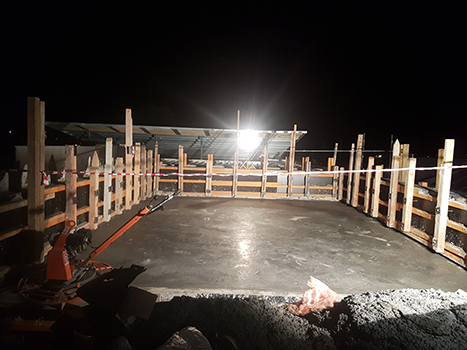
Quality formwork in Sydney means precisely set timber or steel frames that hold their position under the weight of wet concrete. For complex residential builds — split-level homes, irregular block shapes, homes on steep sites — expert formworking is genuinely skilled work. It needs to account for drainage fall, the position of expansion joints, and the structural requirements of the specific build.
4. Steel Reinforcement
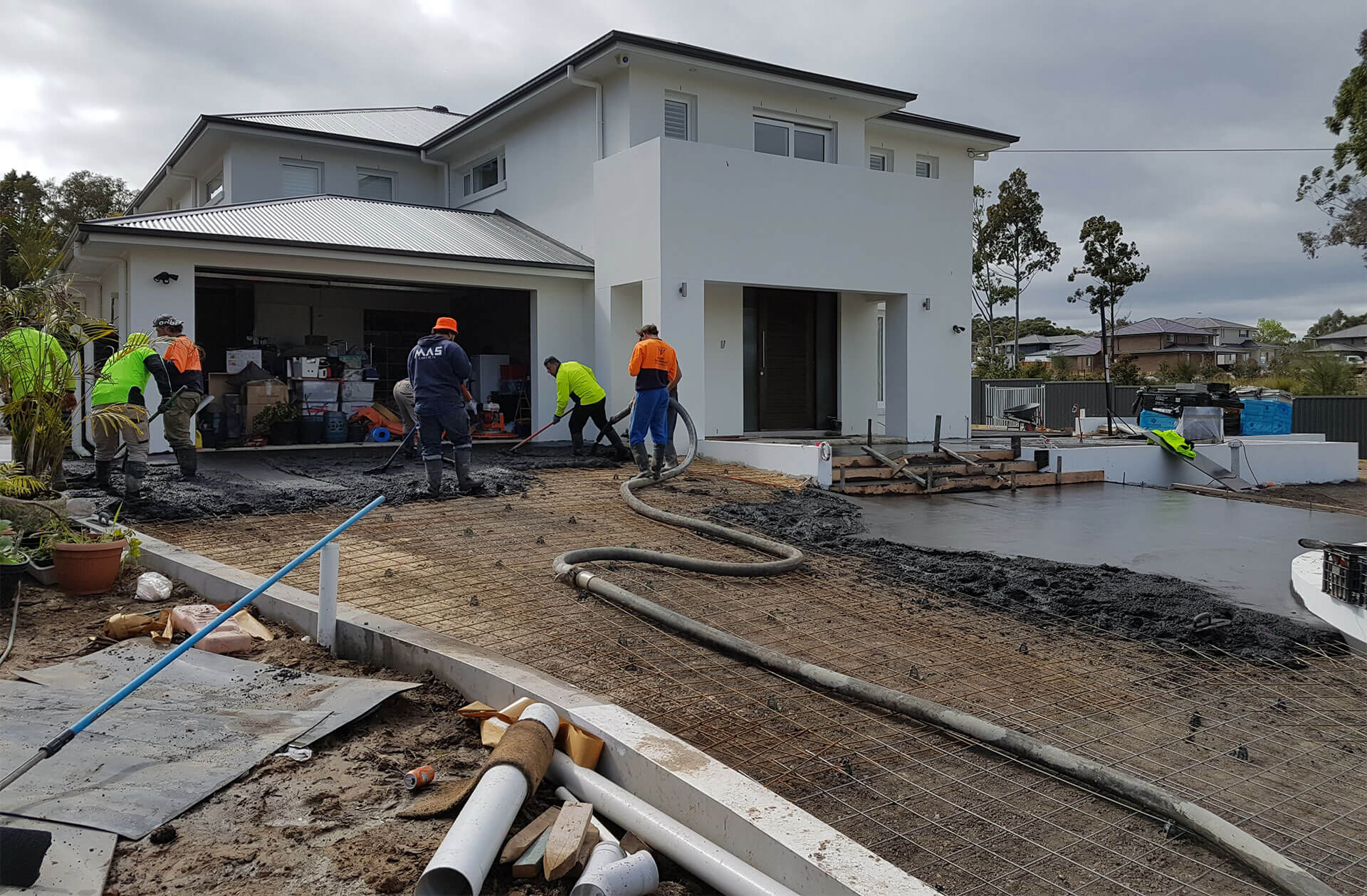
Before the pour, steel reinforcement (mesh or reo bar, depending on the application) gets laid into the formwork. This is what gives concrete its tensile strength — concrete on its own is great at handling compression, but steel is what stops it from cracking under tension and movement. Residential slabs in Sydney typically use SL72 or SL82 mesh, while structural elements like footings may require specific reo bar specifications from an engineer.
5. The Pour and Finishing
Here’s the part everyone pictures when they think of concreting — the truck, the pump, the pour. And yes, this is skilled work too. The concrete needs to be distributed evenly, vibrated to eliminate air pockets, and struck off level before the surface is finished. Depending on the application, finishing might be a broom texture (great for driveways and footpaths — grippy, practical), a smooth steel trowel finish, or an exposed aggregate look. Each finish has its own timing requirements during the curing process.
6. Curing
Concrete doesn’t “dry” — it cures, through a chemical process called hydration. This takes time. A slab needs to be kept moist and protected from direct sun for at least the first 7 days. You shouldn’t drive on a new driveway for at least a week, and full structural strength isn’t reached until around 28 days. Any concreter who tells you otherwise is cutting corners.
Residential Slabs — The Foundation Your Home Depends On
Every new home in Sydney starts with a slab. And yet, the slab is the part of the build that gets the least attention from homeowners — because once the house goes up, you can’t see it anymore. That invisibility can work against you if you’re not careful about who lays it.
Residential slabs in Sydney come in a few main types. Waffle pod slabs are the most common in new suburban builds — they use a grid of polystyrene pods under the concrete to create a rib structure that’s strong and relatively lightweight. Conventional reinforced slabs are poured directly onto a prepared base and are common for renovations and extensions. Strip footings are used where the ground conditions require deeper foundations.
Which one is right for your project depends on your block, your soil classification (which ranges from A-class stable sand to P-class problematic, and everything in between), and your engineering requirements. A competent concreting team will work with your structural engineer’s drawings and execute the slab precisely to spec.
Getting this right isn’t just about structural integrity either — a properly engineered and poured slab is a prerequisite for your building insurance and can affect your property’s resale value. Don’t cut corners here.
Council Driveways and Footpath Crossings — Yes, You Do Need Approval
Here’s something that catches a lot of Sydney homeowners completely off guard: the section of your driveway that crosses the footpath — from your property boundary to the kerb — is not your property. It belongs to the council. And installing or modifying it without approval? That’s a problem.
Every Sydney local government area has specific requirements for vehicle crossings (also called laybacks or crossovers). These govern the width, the gradient, the drainage, the materials used, and the construction methodology. Getting it wrong means council can require you to remove and redo the work at your own cost.
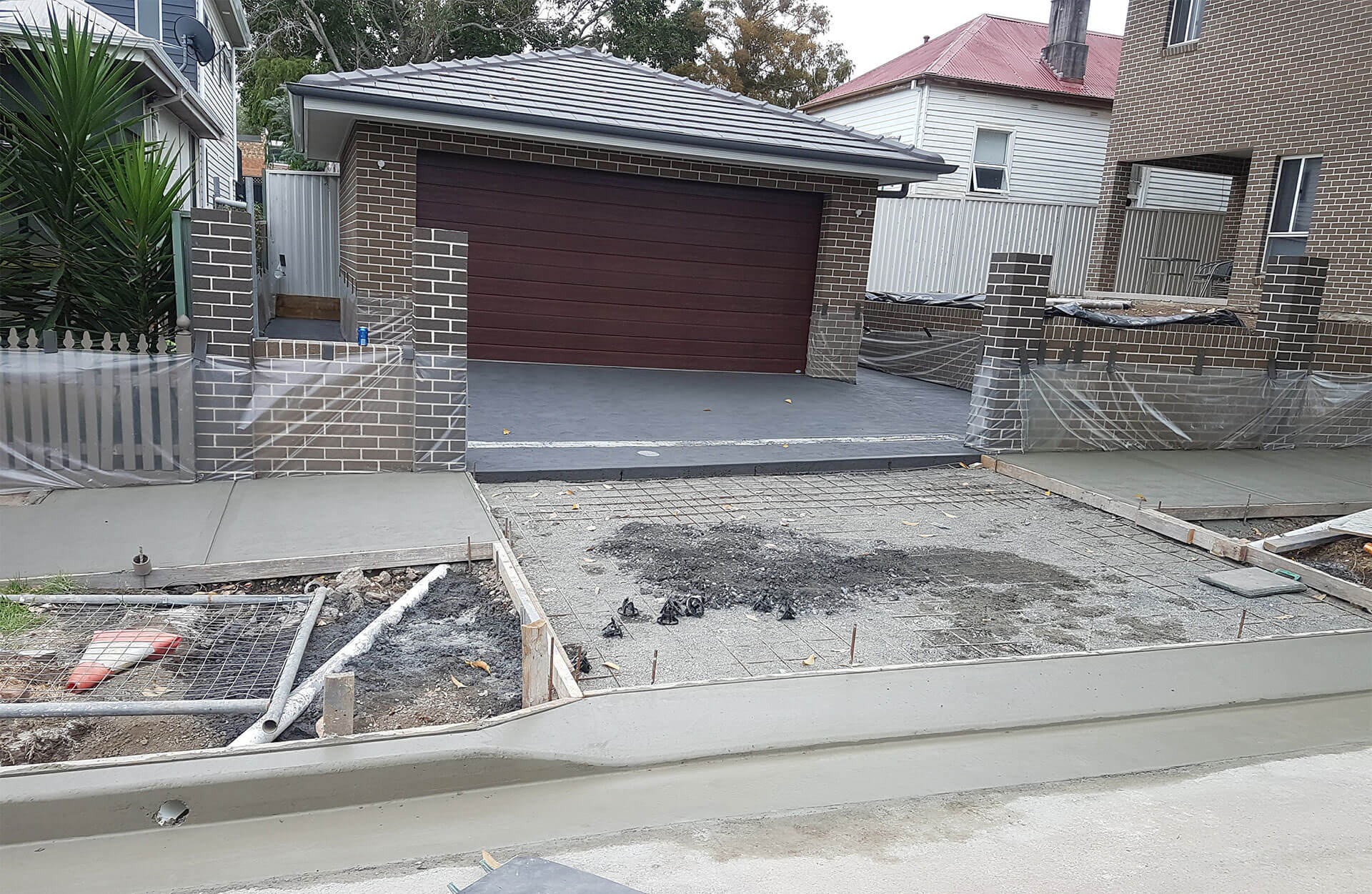
Council-approved driveway concreting in Sydney means handling all of this on your behalf — submitting the permit application, liaising with the council, and executing the works to their specifications. It’s one of those services where experience counts enormously, because a team that’s done dozens of these jobs across different Sydney councils knows the requirements inside out and can navigate the paperwork without delays.
Similarly, council footpath concreting adjacent to residential properties needs to meet council standards for accessibility, gradient, and material. If you’re building a new driveway and the footpath needs to be modified as part of the crossing, that work needs to comply too.
The practical upside of using an experienced team for these jobs? Less stress, faster approvals, and work that’s done right first time — no rectification orders, no re-doing anything at your cost.
Pool Excavation and Residential Earthworks — Digging Down Before You Build Up
Before any pool can be installed, before a basement can be dug, before a retaining wall can be built — there’s earthmoving. Excavation in Sydney is its own specialist skill, particularly given the variety of soil conditions across the metro area.
A proper excavation service assesses the site, uses appropriate equipment for the access constraints (tight inner-city blocks need mini excavators; open suburban sites allow for larger machines), and manages the spoil removal responsibly. For pool excavation specifically, the team also needs to account for the concrete shell that follows — ensuring the pit is the right dimensions, properly benched, and safe for the trades that come in next.
Pool excavation in Sydney often throws up surprises — rock ledges, unexpected utilities, high water tables in low-lying areas. An experienced excavation crew has a plan for all of these contingencies. A fly-by-night operator does not.
What Sets Professional Sydney Concreters Apart
After 20+ years working on residential concreting projects across Sydney, Oz Crete Concrete has built a reputation on a few non-negotiable principles:
Transparency from the start. Every quote is detailed and explains what’s included. No vague line items, no “we’ll work it out as we go.”
Proper preparation, every time. The base work, the formwork, the reinforcement — done right, regardless of the job size.
Clean, professional finish. Concrete work is highly visible on a residential property. The team treats it that way.
Project management. Coordinating with your builder, your architect, your council — that’s part of the service. You shouldn’t have to manage all of that yourself.
And practically speaking, the company is fully insured, experienced with Sydney council requirements, and has a portfolio of completed residential projects across the metro area. You can see the work — not just read about it.
The Full Range of Concreting Services — What’s Actually on Offer
If you’re working through a residential build or renovation in Sydney and wondering what a quality concreting contractor can handle, here’s the practical breakdown. Check out the full services list to see what applies to your project:
Concrete Slabs — House slabs, shed slabs, granny flat pads, carport slabs. Engineered to your specific requirements.
Residential Formwork — Precise, properly braced formwork for slabs, footings, and structural pours.
Driveways — Plain, broom-finish, exposed aggregate, coloured. Council crossover section handled with permits included.
Concrete Footpaths — Council-compliant, properly graded, safe and durable.
Excavation — Cut and fill, pool excavation, site preparation, spoil removal.
Council Crossing Works — The section from your property to the kerb, fully permitted and compliant.
Common Mistakes Sydney Homeowners Make with Concreting
Since you’ve made it this far, let’s make this practical. These are the mistakes that generate the most expensive fix-up calls:
Going with the cheapest quote without understanding what’s included. If one quote is 30% below the others, something is being left out. Find out what.
Skipping proper base preparation. You will not see it. You will absolutely feel it later when the cracks appear.
Not getting council approval for the footpath crossing. The cost of rectifying non-compliant work is always higher than getting it approved in the first place.
Pouring in the wrong weather. Extreme heat causes concrete to set too fast and weaken. A professional team manages timing and uses appropriate admixtures.
Not planning for expansion joints. Concrete moves. Joints control where it moves, so it doesn’t crack randomly across your driveway.
Ready to Get It Done Right?
Concrete is the most permanent decision you’ll make about your property’s exterior. Laid well, it’s there for a generation. Laid poorly, it’s a recurring headache.
If you’re ready to have a proper conversation about your project — whether it’s a new house slab, a council-approved driveway, a footpath modification, formwork for a complex build, or pool excavation — the team at Oz Crete Concrete is worth a call.
Get in touch and request your free quote — no obligation, no sales pressure, just a straight conversation about your job and what it’s going to take to do it properly.
Because at the end of the day, concrete done right is concrete you forget about. And that’s exactly what you want.