By Ozcrete Concrete | Residential & Commercial | Servicing All Sydney Metro
Concrete has a bit of an image problem. It’s the building material everyone uses constantly but almost never thinks about until something goes wrong — the driveway that’s cracking at three years, the house slab that someone assured you would be fine without proper sub-base preparation, the council footpath crossing that’s been rejected twice because the paperwork wasn’t right.
Here’s the reality: concrete done properly is one of the most durable and cost-effective building materials available. Concrete done poorly — wrong mix, skipped reinforcement, rushed curing, inadequate sub-base — can cost you more to fix than the original job cost in the first place. And in Sydney’s 2026 market, with material costs up 8.5% from 2024 and a documented 15% shortage of specialist concreting labour across the metro area, knowing the difference between a quality job and a cheap one has never been more important.
This guide covers everything: the concreting services you’ll encounter on a typical Sydney residential project, what the process looks like from excavation through to the finished surface, what everything costs with real 2026 numbers, and how to get lasting results rather than a slab that’s cracking before the garden’s even established.
Why Concrete Is Still the Smart Choice for Sydney Homes
Before we get into process and costs, it’s worth understanding why concrete remains the dominant choice across Sydney residential construction — because there are now more alternatives than ever, and the comparison matters.
Longevity. A properly designed and poured concrete surface in Sydney lasts 30–50 years with minimal maintenance. Pavers shift and settle. Asphalt softens in Sydney’s summer heat. Gravel migrates. Concrete, done right, stays put for decades.
Load capacity. Sydney’s SUV-heavy driveways, the house slabs carrying your entire building, the footpaths handling pedestrian traffic plus delivery trolleys plus the occasional reversing vehicle — concrete handles all of it. It’s the only material that scales from a garden path to a multi-storey foundation without changing category.
Versatility of finish. Plain broom finish, exposed aggregate, coloured concrete, stencilled patterns, honed and polished — concrete adapts to virtually any aesthetic requirement. The exposed aggregate finishes that are increasingly popular across Sydney’s northern suburbs offer better slip resistance than smooth surfaces, hide tyre marks and stains, and look better for longer than most alternatives.
Property value. A quality concrete driveway adds measurable value to Sydney residential property — typically $3,000–$6,000 on resale for a premium finish versus a worn or cracked existing surface.
Sydney’s climate demands it. Sydney’s combination of summer heat, variable rainfall, coastal humidity, and the reactive clay soils that underlie much of western and south-western Sydney creates one of the most demanding environments for outdoor surfaces in Australia. Concrete handles it better than any alternative — provided the sub-base, mix design, and reinforcement are right for the specific site conditions.
Concreting Services for Sydney Homes: What’s What
Sydney homeowners encounter several distinct concreting applications. Here’s a clear breakdown of what each involves.
House Slabs
House slabs in Sydney are the most structurally critical concrete work a residential property will ever have done — the foundation everything else sits on. Getting this wrong is not a recoverable situation.
A residential house slab in Sydney involves engineering design (required by council for new builds), soil testing, site preparation, formwork, reinforcement installation (typically SL82 mesh plus perimeter and internal beams for Sydney’s soil conditions), and the concrete pour itself. For slabs built on Sydney’s reactive clay soils — classified as Class H1 or H2 under AS 2870 — deeper edge beams, additional reinforcement, and careful drainage design are non-negotiable engineering requirements, not optional extras.
What it costs: House slabs in Sydney typically range from $110–$150+ per square metre depending on engineering requirements, soil classification, site access, and thickness. For a standard 150m² home footprint, budget $16,500–$22,500+ for the slab itself, excluding excavation.
Driveways
Concrete driveways are one of the most common residential concreting projects across Sydney — and one of the most frequently done incorrectly by operators who skip the preparatory steps that determine whether a driveway lasts five years or fifty.
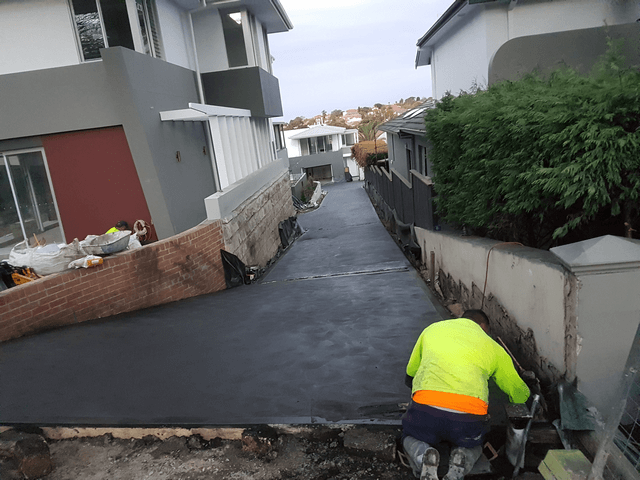
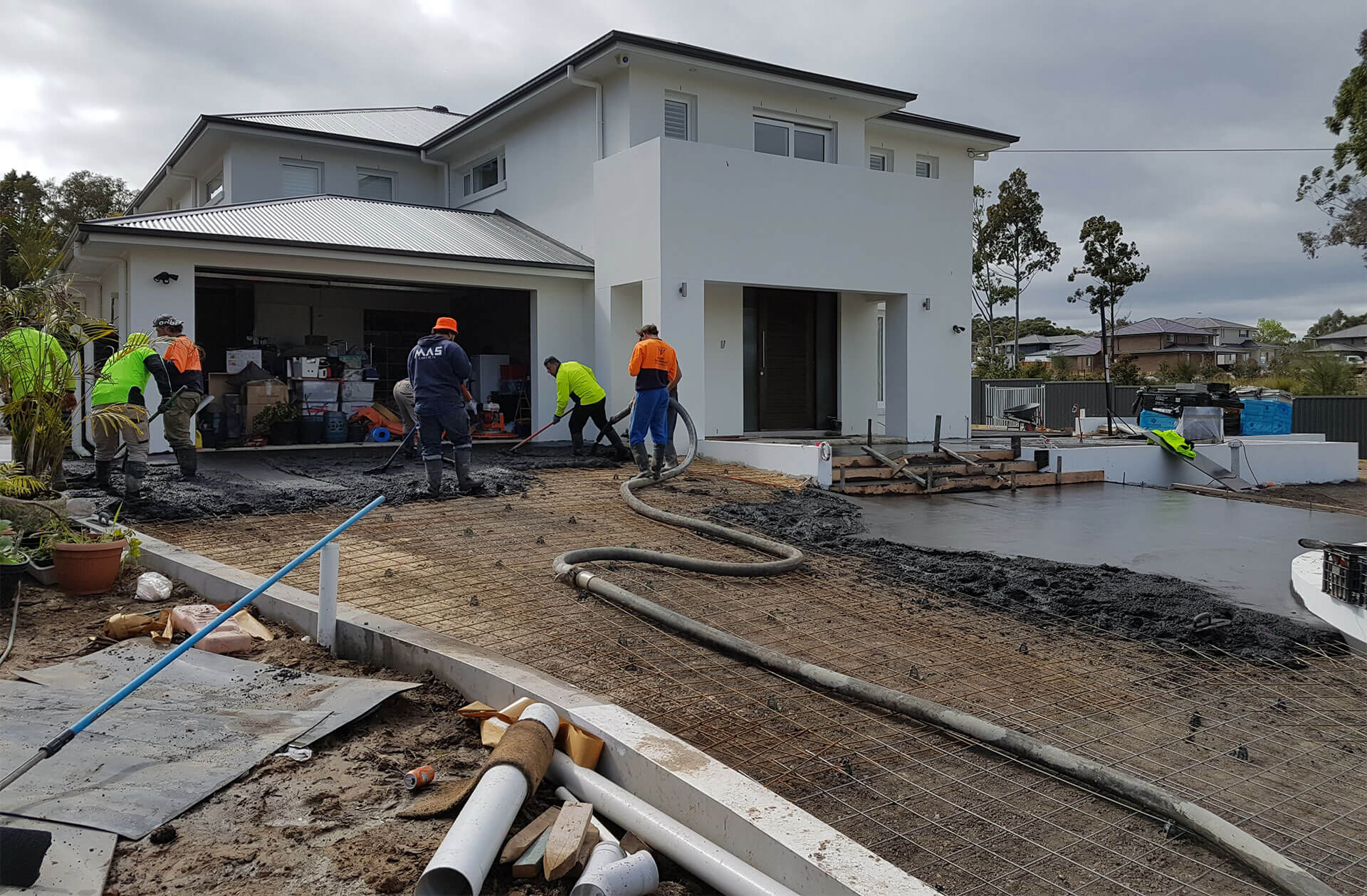
The right process: 100–150mm excavation to remove topsoil and organic material; compacted road base (minimum 75–100mm); SL72 mesh reinforcement for standard vehicles, SL82 for driveways that regularly carry SUVs or trade vehicles; formwork; concrete pour at 100mm thickness minimum; surface finish; expansion joints cut within 24 hours of pour; 7-day light curing before pedestrian traffic, 28 days before vehicles.
What it costs in 2026: Plain broom finish driveways run $95–$130/m². Coloured concrete adds $100–$150/m². Exposed aggregate — currently the most popular finish for Sydney driveways — runs $140–$220/m². A standard double driveway (40m²): $3,800–$5,200 plain; $5,600–$8,800 exposed aggregate. These figures include excavation, sub-base, mesh, pour, and finish.
Footpaths
Footpath concreting in Sydney covers both private footpaths within your property (garden paths, side paths, around-the-house access paths) and the council footpath — the footpath between your boundary and the road that councils manage but which you’re often responsible for maintaining.
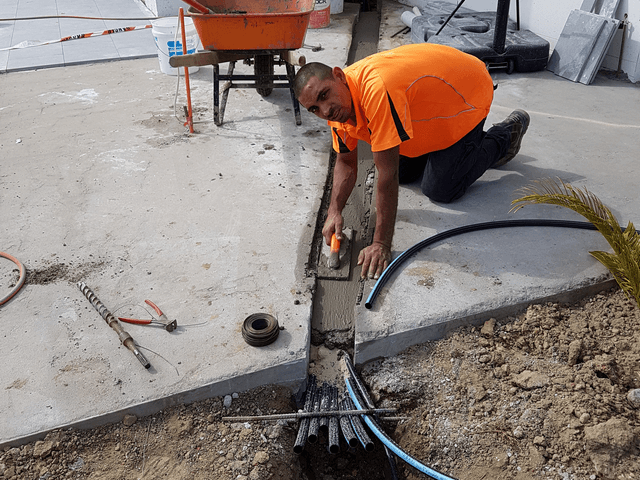
Private footpath concreting is straightforward: site prep, formwork, 75–100mm pour, broom or broomed aggregate finish for slip resistance, expansion joints at regular intervals. Council footpath work is considerably more involved — see the council driveway section below.
Council Driveway Crossings
This is the concreting project that catches the most Sydney homeowners off-guard. The section of your driveway that crosses the council footpath and connects your property to the road — the “driveway crossing” or “layback” — is technically council infrastructure. If it’s damaged, incorrect, or needs reconstruction for a new driveway or renovation project, it’s your bill but council’s approval process.
Council driveway crossings in Sydney require a council application before any work starts (permit fees typically $150–$600+ depending on council), must be constructed to council specification, and require council inspection before they’re accepted. Getting this process wrong — constructing without approval, or not meeting spec — results in the council requiring you to remove and redo the work at your expense.
An experienced concreter who knows your specific council’s requirements handles the application, constructs to specification, and manages the inspection process. This is not the job to hand to the cheapest quote who doesn’t mention permits.
The Concreting Process: From Excavation to Finished Slab
Most people think concreting is “pour grey stuff, wait for it to dry.” Here’s what actually happens — because understanding the process helps you evaluate quotes and spot the operators who are cutting corners.
Stage 1: Excavation
Professional excavation in Sydney removes topsoil and organic material to the required depth — typically 150–250mm for driveways, more for house slabs depending on engineering and soil type. Underground utility locations are identified before any machine touches the ground — damaging a water main or NBN cable is a very expensive mistake that a pipe locating service ($150–$350) prevents entirely.
On Sydney’s reactive clay sites, the excavation depth and sub-base specification are determined by the site’s soil reactivity classification. Class H1 sites need deeper edge preparation than Class M sites; Class H2 sites require even more. Skipping the soil assessment on a western Sydney property and treating it like a stable sand site is how you get a driveway that cracks within two years.
Excavation costs in Sydney typically run $25–$60/m² depending on depth, soil condition, and access. Disposal of excavated material adds $500–$5,000+ depending on volume and material type — clean fill is cheaper to dispose of than contaminated material.
Stage 2: Sub-Base Preparation
Compacted road base (DGB20 or equivalent) is laid and compacted in layers to achieve the specified density. For driveways, 75–100mm compacted depth is the minimum; for house slabs, engineering specification determines the requirement. This is the invisible layer that does most of the structural work — it distributes load from the surface into the ground and prevents differential settlement.
This step is the single most commonly skipped or underspecified element in cheap concreting jobs. A slab poured directly on uncompacted fill or inadequate base will crack — it’s a question of when, not whether.
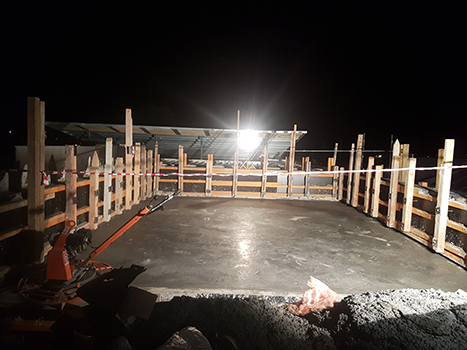
Stage 3: Formworking
Formwork in Sydney concreting creates the mould that defines the shape, dimensions, and level of the finished slab. Properly set formwork is what produces a concrete surface with consistent thickness and correct falls for drainage. Poorly set formwork produces a slab that’s 80mm thick in one corner and 130mm in another — which creates differential strength and the stress concentrations that lead to cracking.
For complex shapes, curves, or slabs with level changes, formwork is where an experienced concreter’s skill is most visible. Setting out a curved exposed aggregate driveway around an established garden on a sloped Sydney block is a significantly different task from a simple rectangular pad on flat ground.
Stage 4: Reinforcement
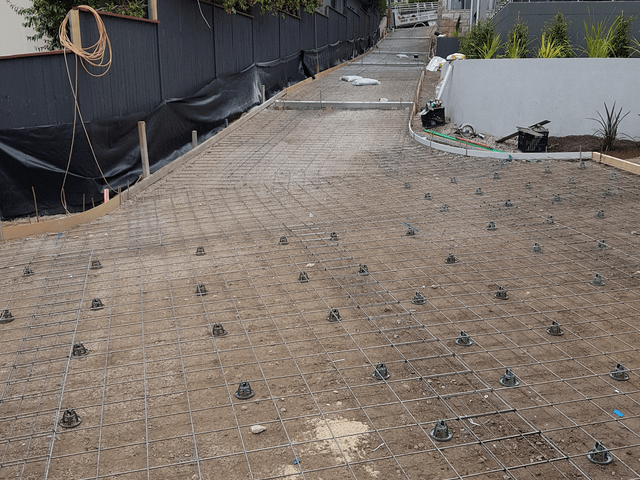
Steel mesh (SL72 or SL82 depending on application) or rebar is positioned within the formwork on bar chairs that hold the steel at the correct depth within the slab — typically in the lower third of the slab thickness. Correctly positioned reinforcement provides tensile strength that concrete alone lacks. Reinforcement sitting on the ground because bar chairs weren’t used is essentially doing nothing useful.
For house slabs and commercial applications, the reinforcement schedule is specified by the structural engineer and must be installed exactly as designed.
Stage 5: The Concrete Pour
The ready-mix concrete truck arrives and the pour begins — this is usually the fastest part of the entire process and the part that requires the most coordinated effort. Concrete is placed, consolidated (vibrated to remove air pockets), and screeded to level within a specific time window before initial set begins. In Sydney’s summer heat, that window can be as short as 90 minutes.
For larger pours or sites without direct truck access, a concrete pump is required — typically $450–$650 per visit in the Sydney metro area. Pump hire adds to the cost but is often essential for getting concrete to second-storey slabs, back gardens, or sites with restricted vehicle access.
Stage 6: Finishing
Surface finish is applied while the concrete is in the appropriate workability window. Broom finish is the most affordable and provides good slip resistance. Exposed aggregate is achieved by washing the surface before full set to reveal the decorative stones in the mix. Coloured concrete uses oxide pigments mixed into the batch. Each finish has its own timing window and requires different techniques to execute well.
Expansion joints are cut into the slab within 24 hours of pour — these control where the concrete cracks (which it will do as it cures and as it thermally cycles) so that cracking occurs in predictable, manageable locations rather than randomly across the surface.
Stage 7: Curing
Concrete reaches approximately 70% of its design strength in 7 days and full strength at 28 days. During this curing period, the surface must be protected from rapid drying — particularly in Sydney’s summer sun and wind — using curing compounds, wet hessian, or plastic sheeting. Rain on freshly poured concrete within the first few hours weakens the surface layer significantly.
The practical implications for you: Don’t drive on a new driveway for 7 days minimum; 28 days is ideal. Don’t place heavy point loads on a new slab in the first month. And if your concreter finishes and leaves without any mention of curing requirements — that’s a red flag.
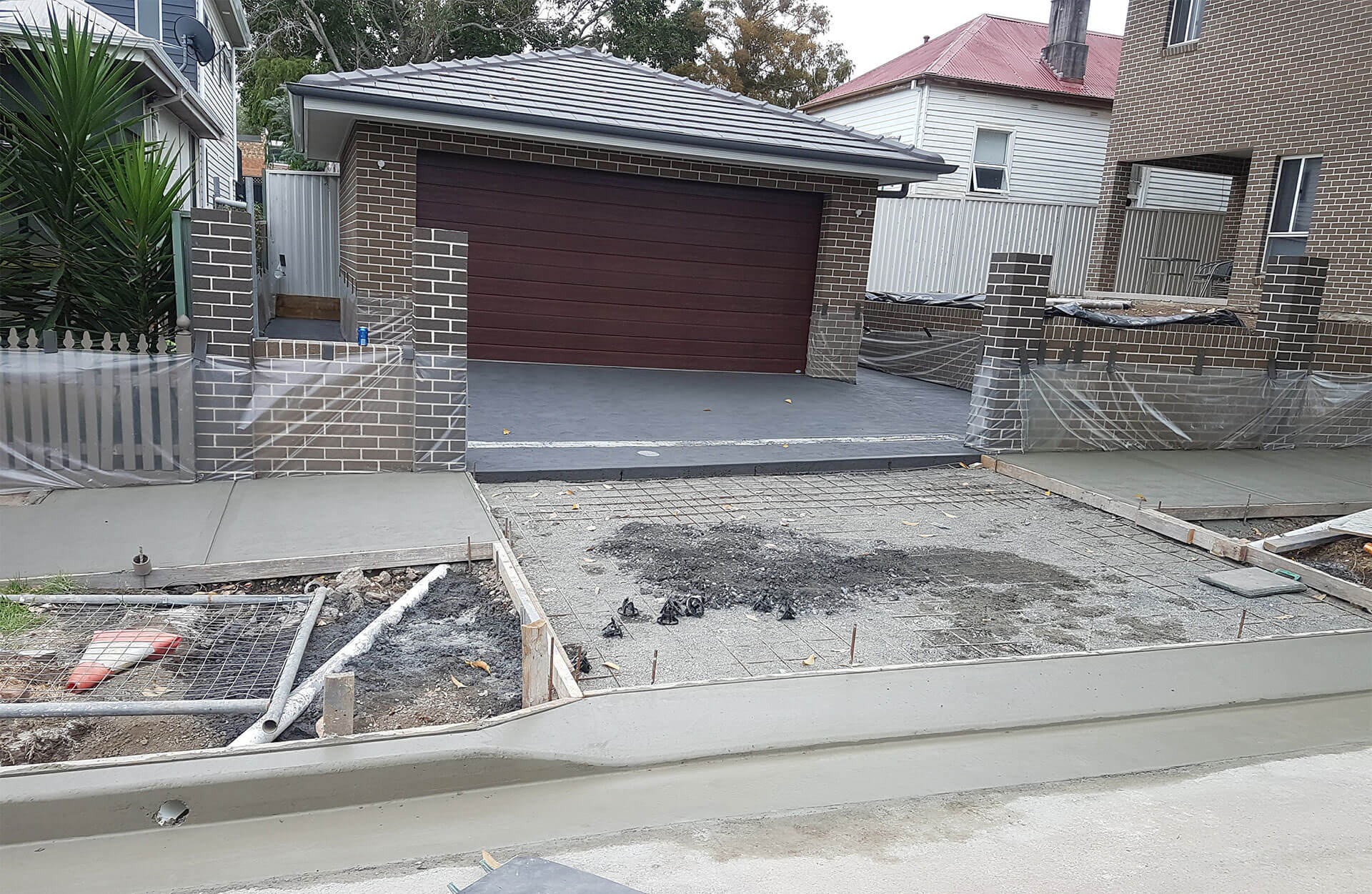
BrowseOzcrete’s gallery to see completed projects across Sydney at every stage, from excavation through to finished surfaces in multiple finish types.
Concreting Cost in Sydney: 2026 Price Guide
Here’s a comprehensive 2026 price guide based on verified Sydney market data:
Service
Cost per m²
Typical Project Total
Plain broom finish driveway
$95–$130
$3,800–$5,200 (40m²)
Exposed aggregate driveway
$140–$220
$5,600–$8,800 (40m²)
Coloured concrete
$100–$150
$4,000–$6,000 (40m²)
House slab (residential)
$110–$150+
$16,500–$22,500+ (150m²)
Footpath (private)
$80–$120
$800–$2,400 (10–20m²)
Council driveway crossing
$95–$170
$1,900–$5,100
Add-ons that affect your total:
Excavation: $25–$60/m² — significantly more for reactive clay sites requiring deeper prep
Old concrete removal: $30–$60/m² — 50m² of demolition generates approximately 12 tonnes of waste
Concrete pump hire: $450–$650 per visit when truck access isn’t possible
Drainage installation: $500–$2,000+ depending on system complexity
Council crossing permit: $150–$600+ depending on council
Steep sites: Add 15–25% for sloped driveways requiring additional labour and pumping
The inflation reality in 2026: Material costs have risen 8.5% since 2024 and qualified concreting labour is 15% tighter than 2023 levels across Sydney metro. This is reflected in all current quotes — a quote that looks dramatically below these ranges deserves a question about what’s being left out.
Affordable Concreting in Sydney: What Real Value Looks Like
“Affordable” in concreting doesn’t mean the lowest number on a quote. It means the best long-term outcome per dollar spent — and in concrete, the long term is measured in decades.
Here’s how to get genuine value:
Get three itemised quotes. Every quote should specify the excavation depth, sub-base type and depth, reinforcement specification (SL72 vs SL82, bar chairs included), concrete strength (MPa), finish type, and what’s included in the price (excavation, disposal, pump hire, expansion joints, curing). A quote without these details doesn’t allow fair comparison.
Don’t skip the sub-base. The most common source of cheap quotes is reducing or eliminating the road base layer. It saves the operator $300–$800 on the job and costs you a cracked driveway within three years. Ask specifically: “What sub-base are you using and how deep?”
Understand the site conditions. Sydney’s reactive clay soils in western and south-western suburbs — Blacktown, Penrith, Campbelltown, The Hills — require more preparation than stable sandy soils. A quote that doesn’t account for your site’s soil type isn’t accounting for your actual job.
Use the full range of services. Need excavation plus a driveway plus a footpath? Combining work in a single mobilisation saves significantly on establishment costs. The crew and equipment are already on site.
Whether it’s a new house slab, a driveway replacement, a council crossing, or a footpath that’s been meaning to get done —Ozcrete Concrete provides professional residential and commercial concreting across all Sydney metro suburbs.
We provide free, written, itemised quotes. We specify every element of the scope upfront — sub-base, reinforcement, concrete strength, finish, curing. No surprises on the invoice.
Because good concrete lasts a generation. It’s worth doing properly.
Ozcrete Concrete provides professional residential and commercial concreting services across all Sydney metropolitan suburbs, including house slabs, driveways, footpaths, council driveway crossings, excavation, and formworking. Free quotes available. Call today.
Good quality residential concreting Sydney is a vital aspect of all modern constructions and we at Oz Crete Concrete are the professional residential concreters Sydney that offer top quality services at the most competitive pricing.
Concrete is extremely versatile and easy to mold and finish when in a semi-liquid form. Once it solidifies, it is extremely durable and strong, which makes it a highly reliable and ideal material for all types of constructions. Today, concrete is widely used in residential buildings to make them resilient and long-lasting.
Residential Concreting Sydney
_
With over 20 years of experience in the field, we have made our mark as the best concrete Sydney and handle projects of all shapes and sizes. Whether you need a slab installation done for your new home construction or need the formwork completed, we can handle it all. Our team of Sydney concreting experts have handled scores of projects of different types and has the qualification, skill, and expertise to tackle every job expertly and to the 100% satisfaction of our clients.
Best Quality Concrete Sydney
_
As a customer-centric company, we are focused on providing custom solutions that meet your needs and fit your budget. We offer premium residential concreting Sydney solutions for a variety of requirements. In residential projects, our team of experts liaises with individual homeowners, architects, engineers, and contractors and completes projects methodically and expertly. The goal is to plan and build features that will be long-lasting and appealing as well.
Services
_
Our Services
Based on your specific needs, we use poured/pre-cast concrete to achieve a very neatly-finished surface. Every job big and small is carried out safely and to industry standards and you are assured of timely completion of the work. We offer a range of residential concreting Sydney services including:
Concreting
As mentioned earlier, we work with homeowners, contractors, builders, and architects and provide tailored solutions for all types of top quality Sydney concreting works. While the actual construction will be handled to perfection, we also focus on aspects such as finishing as this determines the final finish of the structure.
We are one of the front-running professional. When you hire us for house slab installations, you can rest assured that you’re hiring the best. Our team will work with you and your builder/architect to ensure that the final product is in line with the project requirements. Our focus is on creating resilient and durable slabs.
In addition to being the best concreter Sydney, we also offer excavation services. Our experienced and skilled excavation team handles all types of cut and fill earthworks for residential developments. We have vast experience in this space and have what it takes to provide top-notch services to our clients.
Regardless of the types of residential Sydney concreting and form working services you need, we have you covered. All of our technicians have the required certifications and experience to handle projects of all types. We use the latest techniques and technology, ensuring you get the best services at the lowest cost.
If you are looking for a low-cost concreter Sydney, you are at the right place. Footpath concreting is a specialized job that requires specific skills, training and a good amount of experience and we have all this and more. Depending on the needs of your project, we can install concrete footpaths in a range of colors, finishes, and textures.
We provide top quality council driveway concreting services throughout Sydney and its suburbs. We recognize that every project is unique and that it comes with its own set of challenges. We handle all types of council driveway concreting Sydney projects using the latest equipment to ensure minimal disruption.
We are the cheap concreter Sydney that is honest and transparent in its business dealings and always maintain upfront pricing. This means you never have to worry about any tacked-on fees and charges when you've presented the final bill. Over the years, we have built a very strong reputation in the industry and have a large number of returning and referred clients. This goes to show how much they trust that we will provide the best services.
Why Choose Us?
_
With a diverse portfolio of residential clientele, we have an impeccable record of efficiency and reliability. Our team of experienced residential concreting Sydney professionals is industry-certified and qualified. We maintain the highest quality standards in service and product delivery. Here are some reasons why clients across the region opt for our services:
Over 20 years of experience
Fully-licensed and insured
Reliable and safe working
High-quality solutions
Value and quality
Professional performance
Top-notch project management
Affordable, upfront pricing
Guaranteed workmanship
100% customer satisfaction
Who we are
_
About Us
Oz Crete Concrete is one of the leading residential concreters Sydney and we have created a distinct niche for ourselves in this industry. For over 20 years, our company has delivered industry-leading services to projects of different sizes and complexity. With each project, our aim is the same- to work closely with clients to provide top quality Sydney concrete work and create appealing and functional spaces.
Our passion for planning & constructing features that complement their surroundings is what makes us unique in every way. We adopt a tailored approach in all our jobs, making sure that our project management and on-site supervision is infallible. This ensures the timely completion of the project, within the approved budget.
CLIENTS
_
Testimonials
Check out why our customers loves us in each projects
Oz Crete is a professional, courteous, prompt and needless to say, the slab was poured and finished in an extremely timely manner. I have no hesitation in recommending oz-crete and can't wait to see what they do with my “old” driveway soon.
Jessica RossetaRyde
I would like to thank Oz Crete for the fantastic service we have received from them for our concreting needs. We will, of course, come back to Oz Crete with any future jobs and will highly recommend Oz Crete!! Once again, thanks Oz Crete for such superb service.
Nicolas AnelkaRose Hill
Oz Crete has always had very good service. They are reliable, accommodating and the concrete is of a high quality. We have always received a good personal service and have no hesitation in recommending Oz Crete to other people.