A no-BS guide to concreting in Sydney — what it is, why it matters, how it works, and who actually gets it done right.
If you’ve ever stood in your backyard, stared at a crumbling driveway, or tried to explain to a builder what you want your new house slab to look like — and ended up more confused than when you started — this one’s for you.
Concrete is everywhere in Sydney. Under your feet on the footpath, beneath your home’s foundation, in your neighbour’s fancy new exposed aggregate driveway that you’ve been quietly jealous of since March. It’s one of the most used construction materials on the planet, and yet most homeowners have absolutely no idea what actually goes into a quality concreting job.
That ends today.
This guide covers everything: what concreting actually involves, why cutting corners in Sydney’s tricky soil conditions is a disaster waiting to happen, what the process looks like from start to finish, and how to find a local concreting team that won’t ghost you after the deposit clears.
What Even Is “Concreting”? (It’s More Than Just Pouring Stuff)
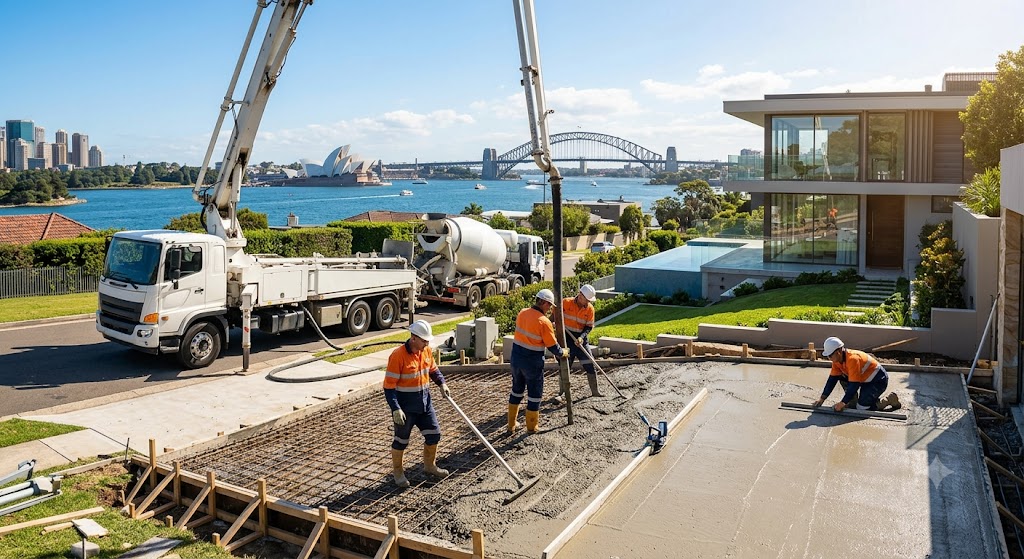
Let’s clear this up right away. Concreting isn’t just a bloke showing up, dumping a truck-load of wet grey stuff, and smoothing it over with a rake. A well-executed concrete project involves site assessment, ground preparation, formwork construction, reinforcement placement, the pour itself, and finishing — all done in the right sequence, in the right conditions, to Australian Standards.
Get any one of those steps wrong, and you’re looking at cracking, sinking, uneven surfaces, water pooling where it shouldn’t, or in the worst case, structural issues that cost a fortune to fix.
Oz Crete Concrete has been handling residential concreting across Sydney for over 20 years. That’s 20 years of watching what happens when you rush the prep work, use the wrong mix for the conditions, or skip the curing stage. Trust us — you don’t want to find out the hard way.
Why Sydney Is Actually a Hard Place to Do Concrete Work (And Why That Matters for You)
Here’s something most people don’t know: Sydney’s soil is notoriously reactive. The Greater Sydney basin sits on expansive clay in many areas — soil that swells when wet and shrinks when it dries. This constant movement is the single biggest enemy of concrete work in New South Wales.
A slab or driveway that’s poured without accounting for this ground movement will crack. Not maybe — will. It’s physics.
This is why experienced concreting contractors in Sydney don’t just order concrete and start pouring. They assess the site, understand the drainage conditions, check the soil classification (usually Site Class M, H1, or H2 under AS 2870 for residential projects), and design the formwork and reinforcement accordingly.
Sydney’s climate throws in another curveball: extreme summer heat. Concrete poured in 35°C+ conditions dries too fast, which causes surface cracking and weakens the final product. Good concreters know how to schedule pours, use retarders when needed, and apply curing compounds immediately after finishing. It’s a skill that only comes with experience.
When you work with the team at Oz Crete Concrete, this isn’t something you need to manage or worry about. It’s just part of how they do business.
The Full Concreting Process — Step by Step
Let’s walk through how a professional residential concreting job actually unfolds. Whether you’re getting a new driveway, a concrete footpath, or a full house slab, the process follows a logical sequence that experienced concreters execute like clockwork.
1. Site Consultation and Planning
Before anyone picks up a shovel, a proper site consultation should happen. This means a concreter walks the property, understands what the client wants, checks the ground conditions, reviews council requirements (especially relevant for driveways and footpaths), and provides a clear written quote.
This step is often where dodgy operators are weeded out. If someone gives you a quote over the phone without looking at your site — run.
2. Site Excavation and Ground Preparation
This is where the heavy lifting begins — literally. Depending on the project, excavation can mean removing topsoil, tree roots, old concrete, or even significant earthworks to level a site for a new house slab.
Oz Crete’s site excavation services handle the full earthworks component, including cut and fill, removal of unsuitable material, and preparing a stable, compacted base. A properly compacted sub-base is non-negotiable for long-lasting concrete. Skip it, and you’ll be re-doing the job in five years.
3. Formwork Construction
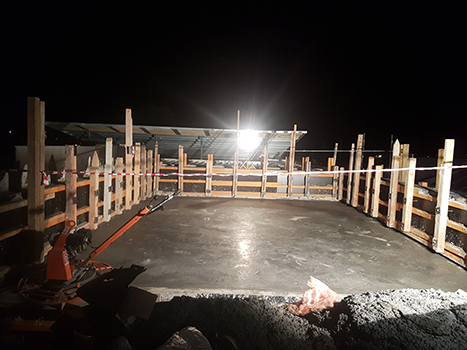
Formwork is the temporary structure that holds the wet concrete in place while it cures. Think of it as the mould for your finished slab, driveway, or footpath. It needs to be perfectly level, structurally sound, and positioned with absolute precision.
Residential formwork in Sydney is a skilled trade in its own right. The timber (or steel) forms must hold against the lateral pressure of wet concrete, which can weigh over 2,400kg per cubic metre. Poor formwork = blowouts, uneven edges, and expensive remediation.
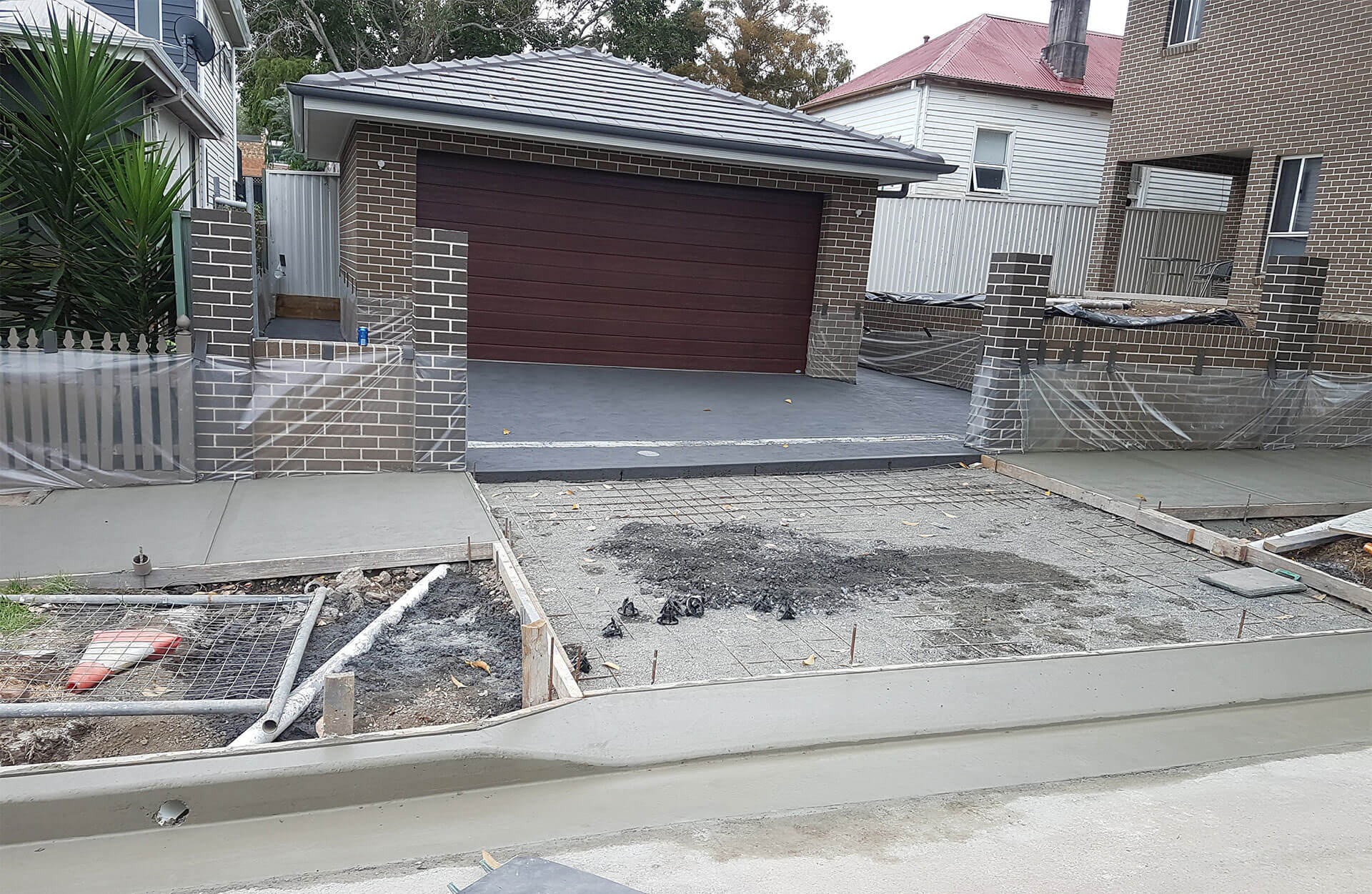
4. Steel Reinforcement Placement
Concrete is incredibly strong in compression but relatively weak in tension. That’s where steel reinforcement (mesh or rebar) comes in. It’s placed inside the formwork before the pour, adding tensile strength and dramatically reducing the risk of cracking under load.
For house slabs, trench mesh goes into the edge beams and SL72 or SL82 mesh covers the internal area. The specific reinforcement is determined by the structural engineer’s design, the site classification, and the loads the slab needs to carry.
5. Concrete Pour and Finishing
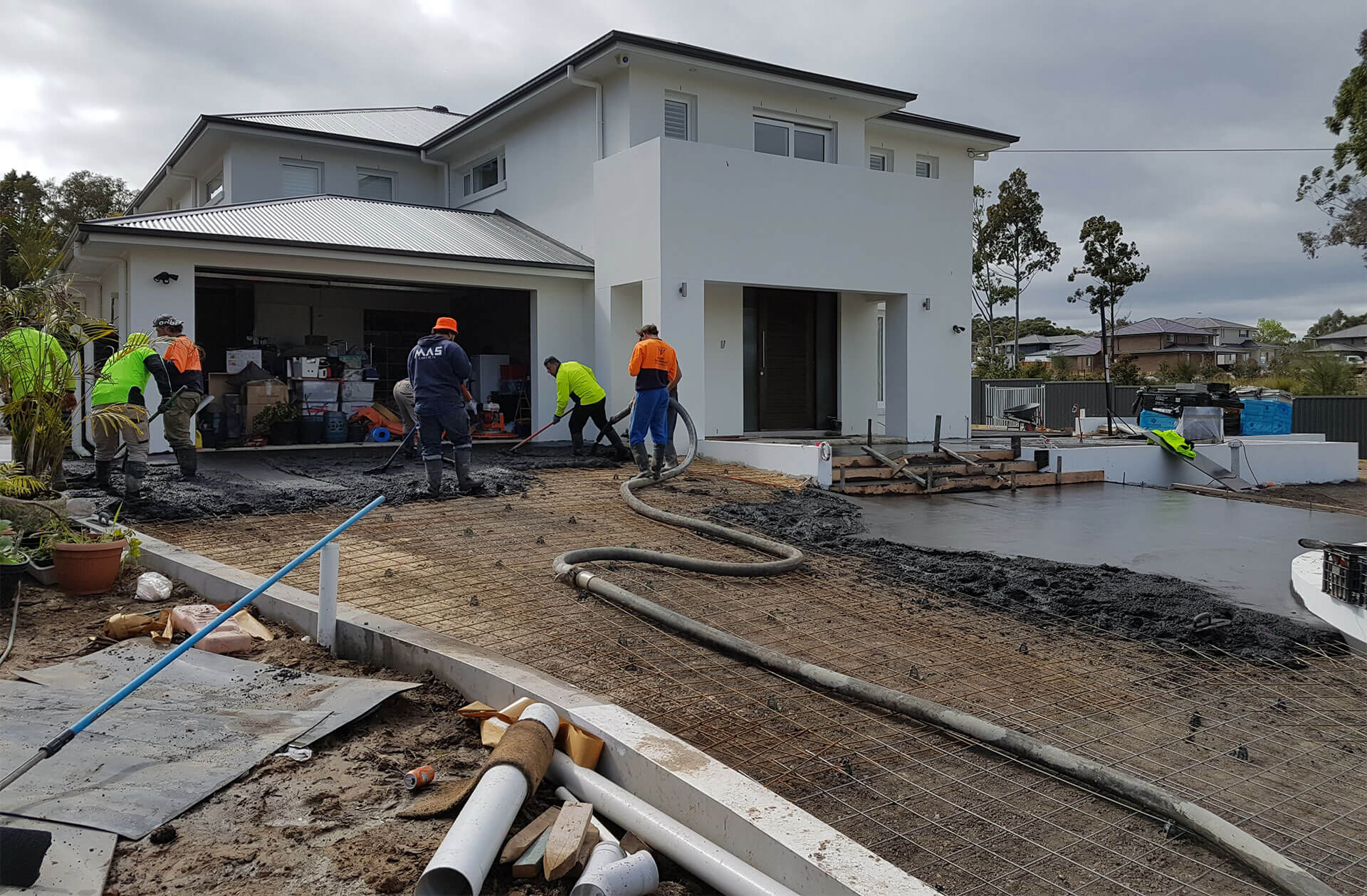
The actual pour. Concrete arrives by truck (or is pumped for larger slabs and difficult access), is placed inside the formwork, compacted with a vibrator to eliminate air pockets, and then screeded level. From there, the finishers take over.
Finishing determines the surface texture: broom finish for driveways (slip resistant), steel trowel for indoor slabs (smooth), exposed aggregate for decorative work. This is an art form that takes years to master — good finishers are worth their weight in gold.
6. Curing
Concrete doesn’t “dry” — it cures through a chemical process called hydration. This process continues for 28 days, but the first 24–72 hours are critical. During this period, concrete must be protected from sun, wind, and temperature extremes that would cause it to dry too fast.
Professional concreters apply curing compound, cover slabs with wet hessian or plastic, and advise clients on how long to keep foot and vehicle traffic off the surface. Skipping this step is one of the most common causes of premature cracking.
Concreting Services Available Across Sydney — What Can Actually Be Done
Concrete House Slabs
The foundation of your home — literally. A poorly done slab creates structural problems that propagate through every floor, wall, and ceiling above it. Concrete house slabs in Sydney need to account for reactive soil, termite barriers, plumbing penetrations, drainage falls, and compliance with NCC (National Construction Code) requirements.
Oz Crete handles the full scope: excavation, edge beam construction, mesh placement, the pour, and the screed finish — coordinating with your builder and trades throughout.
Council Driveway Concreting
This is where it gets a little more complicated. In Sydney, if your driveway connects to a public road, it’s not just a private concrete job — it involves council approval and specific construction standards that vary between local government areas.
A council driveway in Sydney (also called a vehicular crossing or layback) must comply with the relevant council’s specifications for dimensions, cross-fall, kerb ramp design, and materials. Councils like Bayside, Blacktown, Hornsby, and Inner West all have slightly different requirements.
The team at Oz Crete handles council driveway concreting across Sydney — including the paperwork, the liaison with council inspectors, and the construction itself. That’s one less headache for you.
Concrete Footpaths
Whether you’re a homeowner wanting a clean concrete path from your front gate to your door, or you need a council-compliant footpath construction as part of a development, footpath concreting is all about accuracy.
Falls (the slope for water drainage), edge profiles, control joints (the cuts that prevent random cracking), and surface finish all matter. A wonky footpath is not just ugly — it’s a trip hazard and a liability. Check out Oz Crete’s footpath concreting services for residential and small commercial projects across Sydney.
Residential Formwork
Not every job is a simple ground-bearing slab. Multi-storey homes, steep blocks, or structures built above ground level require suspended slab formwork — a more complex system involving false-work (temporary supports), proprietary systems like Bondek, and precise engineering.
Formwork for suspended slabs is a specialist skill. Oz Crete’s formwork team in Sydney handles residential and light commercial formwork, bringing the precision and safety practices the job demands.
Why DIY Concreting in Sydney Is Usually a Terrible Idea
Every year, well-meaning homeowners decide to “just do it themselves” — they hire a mixer, order a few cubic metres of concrete, rope in a mate or two, and get to work. Sometimes it turns out okay. Often, it turns out expensive.
Here’s what typically goes wrong:
The sub-base isn’t compacted properly because nobody owns a plate compactor. The formwork isn’t level, so the finished surface drains toward the house instead of away from it. The pour happens on a 33°C January day because that’s the only weekend everyone was free, and the surface cracks within a week. The finishing looks fine for a month, then the exposed aggregate starts popping off.
Beyond the quality issues, DIY concreting can create compliance problems. If your new driveway doesn’t meet council specs, you may be asked to remove and redo it — at your own cost. If a house slab doesn’t comply with the relevant Australian Standards, it can affect your building certification.
The truth is, for most residential concreting projects in Sydney, professional installation pays for itself — in longevity, compliance, and avoiding the cost of remediation.
How to Choose the Right Concreting Contractor in Sydney
The Sydney concreting market is crowded. There are excellent operators and there are opportunists. Here’s how to tell the difference.
Check for licensing. In NSW, residential building work over $5,000 (including labour and materials) requires a licensed contractor. Check the licence on the NSW Fair Trading website before signing anything.
Ask for references and photos. Any experienced concreter will have a portfolio of completed jobs. If they can’t show you examples of their work, that’s a problem.
Get three quotes — but don’t just go with the cheapest. Wildly low quotes usually mean corners are being cut somewhere: cheaper concrete mix, skipping reinforcement, not doing proper excavation.
Check their understanding of council requirements. If you’re doing a driveway or footpath that connects to public land, your contractor needs to understand the approval process for your specific council area.
Ask about curing. Seriously. Ask them what curing method they use. If they shrug or say “it’ll be fine,” walk away.
Oz Crete Concrete ticks every one of these boxes — licensed, experienced, fully familiar with Sydney council requirements across all LGAs, and committed to doing the job right the first time.
The Benefits of Quality Concrete Work — What You’re Actually Investing In
Longevity That Outlasts Everything Else
Properly installed concrete in a residential setting can last 30 to 50 years with minimal maintenance. Your cheapo pavers? Five to ten years before they’re shifting and cracking. Asphalt driveways? Needs resurfacing every decade. Concrete, done right, is a once-in-a-generation investment.
Property Value
A clean, well-finished concrete driveway, path, and slab setup adds measurable value to a Sydney property. In a market where buyers will pay a premium for low-maintenance homes, high-quality hard landscaping is a genuine selling point.
Safety and Compliance
Uneven paths are a trip hazard. Driveways with incorrect cross-falls pool water near your home, which can cause subfloor moisture issues. A correctly installed concrete surface — with proper drainage falls and slip-resistant finishes — is the safe choice.
Low Maintenance
Compared to other materials, concrete is extraordinarily low maintenance. Occasional sealing, rinsing, and the rare crack repair is all it typically needs. No weeding, no resanding, no replacing individual units.
Serving All of Greater Sydney
Oz Crete Concrete’s services cover the full Greater Sydney metropolitan area — from the Hills District to the Inner West, the Northern Beaches to the Sutherland Shire, the Eastern Suburbs to Western Sydney. Wherever your project is in the basin, the team can get to you.
No job is too small (a short garden path) or too large (a full house slab and driveway package for a new build). The Oz Crete approach is the same regardless of scope: assess properly, prepare thoroughly, pour correctly, and finish to a standard you’d actually be proud to show the neighbours.
Ready to Get Concrete About Your Project?
Whether you’ve got a crumbling driveway that needs replacing, you’re in the planning stages of a new home build and need a slab and formwork team you can trust, or you just need a new footpath put in before someone trips on the old one — the next step is simple.
Get in touch with Oz Crete Concrete for a free, no-obligation quote. They’ll come out, look at your site properly, and give you a realistic assessment of what the job involves and what it’ll cost. No phone-quote nonsense, no surprises on the invoice.
Because the best thing about concrete? When it’s done right, you never have to think about it again.